Whenever I’m stuck on a coding problem, my instinct is to turn to my (senior developer) partner, gesture at the screen, flail at the keyboard and say, ‘Make it work!’

Needless to say, this approach (and yes, I have tried it), does not work.

Knowing how to ask for programming help is a really tricky skill for beginners. For us musicians, we are used to individual lessons where a teacher knows us and our context very well. These teachers often tell us what we need help with and don’t leave space for us to self-direct.

So here’s a basic template (adapt as needed with experience) that you can use to ask for help.

What language and version are you using?

Where/how are you trying to run this code? (E.g. in the browser console, the command line, an interactive shell)

Which operating system (macOS, Windows, Linux) or browser if you’re running it in the browser (Chrome, Firefox, Safari etc) are you using?

What is the context? (E.g. this is a single function or it’s the final stage in a complex web app request or it’s an automated test.)

What is the expected output?

What is the actual output?

What have you tried so far to fix it? (It really helps to keep a record of this. I use a bullet journal.)

What is the critical thing you are trying to do? (E.g. select a random number, receive a 200 status response.)

Which method(s) is/are you using to achieve this thing?

Send code snippets / screenshots!

Send code snippets / screenshots!

Quite often by the time you have answered all these questions, you will have solved the problem. Not all of it will be relevant to your specific problem but it’s good to know anyway! And if you haven’t solved your problem, this gives someone else really useful information to help you.

Got other questions to include? Let me know in the comments!

JavaScript edition:
Have you forgotten to include a return statement?

Photo credit: Jemima Willcox

My name is Paula Muldoon, and I’m a highly trained classical violinist. I have a B.M. (from the University of Michigan) and an M.M (from the Guildhall in London). I’ve recorded in Abbey Road, I’ve performed in Carnegie Hall, and I’ve played in four continents. I’ve been a member of the Orchestre Révolutionnaire et Romantique and the Royal Liverpool Philharmonic Orchestra, and I’ve played with the London Symphony Orchestra and the Philharmonia Orchestra. I’m currently the leader of the Cambridge Philharmonic and the Cambridge String Quartet.

For the past three years, I have also held a full-time job as a software engineer. And in this post, I’m going to tell you why I think you should too.

1. Salary

I’ve been a freelance musician in both the USA and the UK and I hope I never take for granted the unbelievable security of having the same amount of money deposited in my bank account every month. I earned more money as a junior developer in my first job than I ever did as a violinist. And I’ve had roughly a 10% increase in each of my jobs. Plus with salary comes a much easier ability to take out a mortgage. I can’t state what a diffence a regular salary has made to my quality of life, especially to my mental health. (Hey, I can now afford therapy!)

2. Pension

I always said pension was something I’d worry about when I turned 30. Then I turned 30 and became a software engineer, and now I have a tax-efficient, employer-contributed pension. UK law requires employers to contribute at least 3% and employees at least 5% of their salaries to a pension. Yes, I started saving about 8 years later than most employees, but with 35 years of a working life left and an aggressive savings plan now, I am confident I’ll be able to retire comfortably.

Photo credit: Jemima Willcox

3. Healthcare

Less relevant in the UK, but if you live in a barbaric country that doesn’t regard healthcare as a basic human right, this could literally be life-saving. I still remember the time I got a $600 bill after going to the ER in the USA for a strep throat test shortly after I got off my parents’ health insurance. With insurance? No problem. Without? I spent six months paying off that bill. And I didn’t even have strep throat.

4. Holiday/Vacation days

I have 30 days of holiday (plus 8 public holidays). Now I work for a German company, so this is more generous than my UK jobs, which were usually 25 days plus public holidays. Even in the USA, you will still get some holiday! This means you can recharge, rest, go somewhere WITHOUT THE VIOLIN (or whatever your instrument is). It’s taken me 3 years, but I’m finally able to take a violin-free vacation without the feeling I should be practising.

5. Coding is fun

OK, enough with the boring practicalities. Coding is a lot of fun. You can work on all sorts of problems — so far, I have sold shoes online, developed cognitive assessment tests used in clinical trials, and now work in legal tech. Is there an area of the world you care about? You can code there. I actually had no idea whether I would like code before I became a programmer — I just really needed financial stability. Turns out coding is SO MUCH FUN.

Photo credit: Jemima Willcox

6. Musicians have lots of transferable skills

Communication skills, teamwork, analytical minds, desire for excellence, strong work habits.

7. Music can be even more rewarding

I still play lots of music, and I now enjoy it so much more. Everything I do is on my own terms, which means that I turn up for rehearsals and concerts where I want to be there — it’s not for the paycheck.

8. You can still be a professional musician

Lots of programmers have side hustles. Often they are a small code-based business but sometimes they are music! So I have a nice side-income in violin playing / teaching that I love doing (see above) and am in no way dependent on the income. So yes, with Covid-19 I lost a lot of income, but I still have my programming job and just slightly less disposable income (oh yea, you get disposable income).

Photo credit: Jemima Willcox

9. Ethical Considerations

The software industry has a huge issue with lack of diversity, which leads to serious ethical issues — think algorithms that perversely punish people of colour. Musicians bring a tremendously fresh perspective and a mindset geared toward understanding and cooperation. You can make a real difference in the world by coding.

10. It’s not selling out — it’s creating a new path

People look down on musicians who take a day job. I’m calling b*llsh*t on this. Classical music has a very narrow definition of success, which results in many music grads living a financially perilous existence in exchange for the perceived glory of being on stage with a great ensemble. The financial freedom a day job gives allows artists space to be more creative. We need to redefine being a professional musician so that it includes people with all sorts of income rather than stigmatising them as “sell-outs” or “not good enough”.

Hopefully this has given you some food for thought. If you’re a musician considering a career change, check out the resources on my website https://paulamuldoon.com/resources-for-new-programmers/ and get in touch — I’m happy to chat with you.

We’re at a sweet spot now where the demand for programmers still massively outweighs the supply. It’s also the only career where you can train in 3 months and get a full-time well-paid job. If you’re thinking of becoming a software engineer, now is definitely the time to do it. Good luck!

Photo credit: Jemima Willcox

We’ve got an exciting year ahead of us in the Cambridge Philharmonic. Not only do we have a great season of concerts, but we’ve introduced a learning & development plan for the string section as well.

A blank notebook on a wooden desk.

Goals

  1. Improved intonation on tonic and dominant chords.
  2. Playing in the same part of the bow as the front desk

We will be releasing more video and written content throughout the year relating to these goals as well as holding special workshops.

Videos

We will also be releasing a series of eight short videos covering the following topics:

  • Introducing Goal 1: Tonic and Dominant Intonation
  • Introducting Goal 2: Playing in the same part of the bow as the front desk
  • Orchestral practise tips for busy people
  • No accidental bow noises
  • Whose fingering to use?
  • Quick page turns
  • Passing messages back
  • Essential stringed instrument maintenance

Retrospectives

One of the techniques we have learned from the software industry is to have a post-concert retrospective where we ask questions like

  • “What went well?”
  • “What could have been better?”
  • “What should we do differently next time?”

The answers to these questions are then used to guide the preparation for the next concert.

What’s next?

Keep an eye on the YouTube DeskNotes playlist, this blog and social media as we will be releasing the videos Saturday mornings at 10am starting 7 September 2019.

Cambridge Philharmonic Twitter

Paula Muldoon Twitter

#DeskNotes

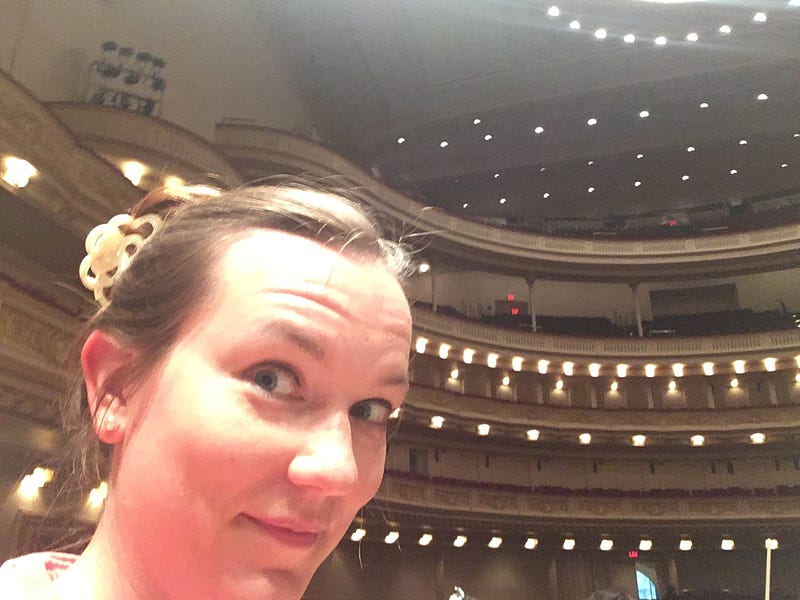
Me at Carnegie Hall

As many of you know, I am both a violinist and a software engineer. I have a Masters degree in violin performance and have played in 20 countries, and a couple years ago I did a programming bootcamp and have been working for 2 years as a software engineer. In my holidays I go on tours (Carnegie Hall last year, Paris this summer) so I have to keep up a high standard of violin playing while also holding down a 9–5 job. So here are my tips for keeping in good musical shape with a busy lifestyle!

1. What to practice?
 I take notes on my phone during rehearsal of tricky passages that need
 work. Then when I start practising, I have a hit list so I don’t faff around wondering what to do.
 
2. Intonation
I’ve used The Tuning CD extensively myself and with my orchestra. It plays overtones so you can really precisely determine your intonation — incredibly eye-opening, depressing at first, but ultimately very cathartic.
 
3. Rhythm
 I also practice frequently with a metronome and it’s something I highly
 recommend. Also if you think you’re playing in time, try recording yourself
 and play along. Metronomes are especially useful in 3/4 and slow 6/8 as
 those are difficult time signatures to keep in tempo.
 
4. Tracking practice
 I use a very fancy Paperblanks journal with a nice pen to record every day
 my start/end times, what I’ve covered, and what I’ve learned. Every month I
 read over what I’ve accomplished that month and set goals for the next
 month (including number of hours to practice). It’s important to have a
 plan with practising so you can tell if you’re being effective.
 
5. Recording
 Recording oneself is SO useful! A smartphone has a plenty good microphone,
 and you can hear so much more when you’re not busy playing. I suggest
 especially before practising rhythm/intonation to record yourself as a
 baseline comparison and then when you’ve finished practising.
 
6. How much to practice
 I set monthly goals based on what’s realistic with my work schedule. While
 practising is about much more than just time, you can’t have good practice
 if you don’t carve out the time to begin with. It’s a lot less than the 4
 hours/day I used to practice as a student but I’ve also become much more
 effective so I get more done in less time. That being said, 15 minutes a
 day is infinitely better than no minutes a day, especially if you have a
 goal and are focused and disciplined. 15 minutes/day 5 days a week is 5
 hours a month!
 
7. Resources
 The Bulletproof Musician blog/podcast has interesting ideas on practising –
 check out the interview with Catherine Cho on how improving a sense of pulse.
Modacity is a practice app built by a French horn player. Built in recording capacity and lots of oher great features.
The Tuning CD — Spotify
The Tuning CD — Apple Music

Where did all my money go?

This is a list of the resources I mentioned in my talk at YouGotThis conference. If you’re interested in an interactive webinar, please submit this Google form to show interest and let me know what you want to learn!

Music

I’m working on recording my Sonata, which you heard part of at the conference. If you want to keep up with my music, head over to https://www.patreon.com/FiddlersCode for updates. I’ll be on iTunes/Spotify soon!

Money Beliefs

Budgeting Software

Irish balanced budget
  • You Need A Budget (YNAB) — this is the one I use and love
  • mint.com — heard good things about this one as well
  • Google spreadsheets, Excel, Apple numbers: great for basic accounting

Got another one you like? Tweet me! and I’ll add it!

Practical Steps

  • Establish how much your essentials (rent, food, transportation, utilities) cost
  • Establish your take-home pay
  • Implement a budget
  • Be kind when you fail

Automate Everything

  • Max out your workplace’s pension
  • Automate all your bills
  • Look out for direct debit discounts!

Bank Accounts

  • Check out Starling and Monzo for great categorisation, tracking and automatic roundups
  • Look at ISAs for saving money

Credit

The credit you build up now affects your ability to buy houses and cars later on in life.

  • Get a credit card and charge an affordable amount to it each month. Make sure you pay it back in full each month!! Lower the limit if they give you a limit that’s too high.
  • Monitor your credit reports with Equifax and Experian — it’s free!

Cyber-security

Get a password manager!!! It will automatically generate long, secure passwords for you and you can keep all your accounts safe, not just the critical ones.

Disclaimer: I am not a financial advisor so please consult a real one and/or do your own research.